

For acquirers
Know what you are acquiring, and what it costs to fix.
At closing, the software becomes yours to own and to run. Before you sign, we examine the code, the infrastructure and the contracts, and report what is there, whether the seller owns it, and what it costs to fix. Every finding is evidenced and, in our standard engagement, verified by an analyst.
- A first report within 72 hours of the data room being ready
- Fixed, published fees
Sign with the technology risk priced in.
You are acquiring a product and the team behind it for what they add to your business. Making the deal is your work. Ours is to settle the technology question before signing, on evidence both sides can check.
What you did not examine, you now own.
Most software acquisitions close on management's account of the technology. Usually that holds. When it does not, the cost surfaces after closing, and it is yours. Here are three ways it happens.

The engineer who knew everything resigns.
The product was built by two people. One has left, the other is leaving, and nobody else can make a release. The roadmap you paid for stalls while a new team learns the code from scratch.
What a review showsKey-person risk: the bus factor, how concentrated the knowledge is, the turnover among contributors and the share of external contributors. Where two people hold the module that carries the revenue, your retention terms should say so.
Where the software must run without its authors
The integration that was going to take a quarter.
The plan assumed the two products could share customers and data by the summer. The interfaces it relied on do not exist, and the estimate was made by people who had never seen the code. The synergies in the model slip with it.
What a review showsWhat is there, what is missing and what it costs to put right, in time to change the plan or the price. The report maps the languages, frameworks and services as they stand in the code, so you see what fits your own stack, what would have to be rebuilt, and where the single points of failure lie.

The breach that began before you signed.
Someone has been inside the systems since before the transaction. It comes to light on your watch. The notification, the regulator and the remediation bill are now yours.
What a review showsKnown vulnerabilities and secrets left in the code and its history, set out before you take them on.
The review takes days, and the fee is fixed.
The issues that derail software transactions are few and well known: who owns the code, who can still build and run it, what is exposed, and what it costs to fix. The evidence is in the code and the contracts. Our technology reads both, so the work takes days.
A first report.
Within 72 hours of the data room being ready.
Verified by our analysts.
Our analysts verify the findings, remove the false positives and write the summary for your committee.
Led by a senior expert.
For platform acquisitions and contested valuations.
Our fees are fixed and published. Fees The levels of engagement
The questions an owner has to answer before signing.
From closing, the software and the people who understand it are your responsibility. We answer from the code and the contracts in the data room, and test management's account against them. The answers do three things for you.
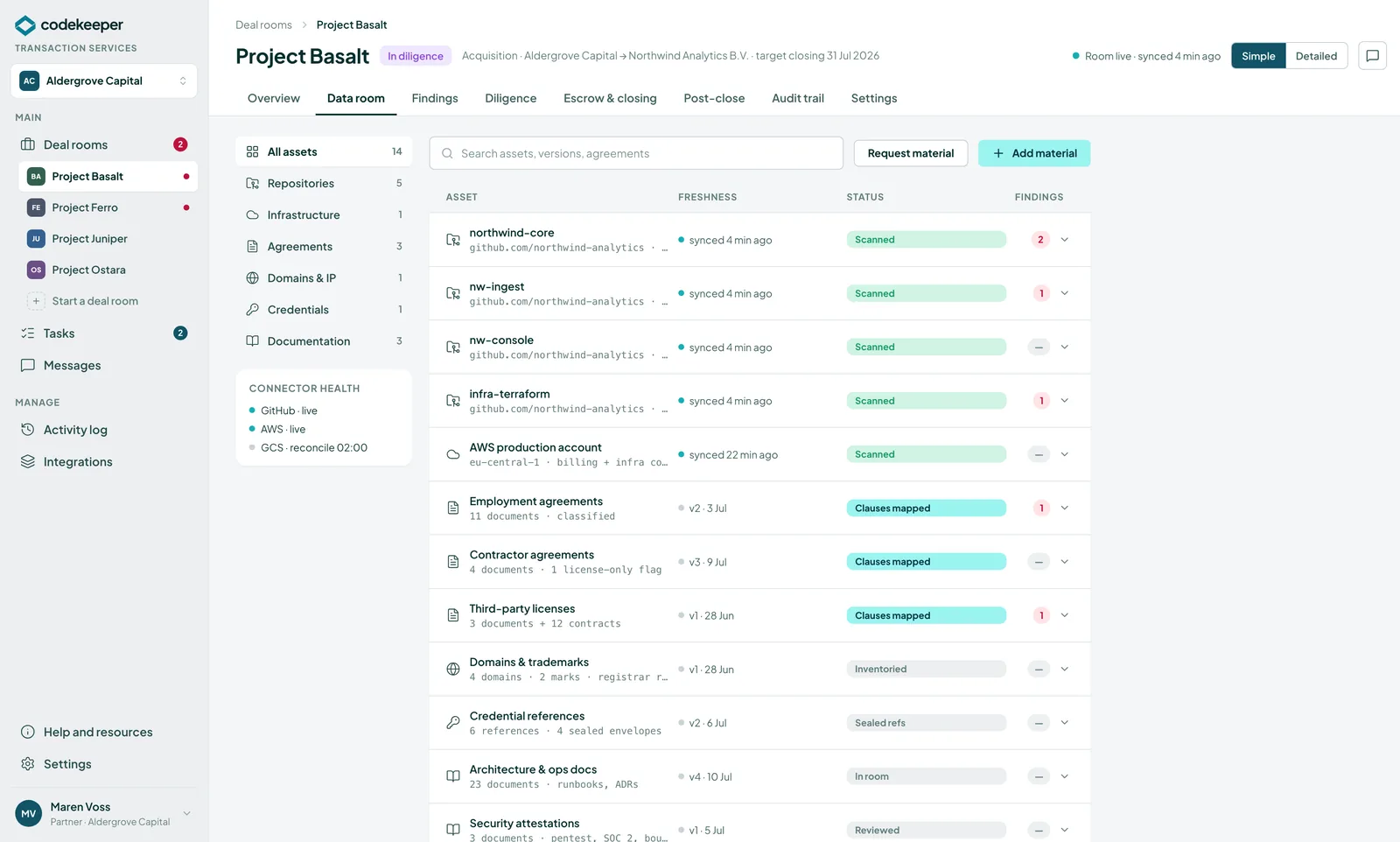
De-risk the deal.
Page one says whether anything should stop the acquisition: the overall risk rating, the principal risks and any deal blockers.
Behind that page we establish whether the seller owns what it is selling. We map each assignment of intellectual property in the seller's agreements and compare it with the contributors in the code history. The report also estimates the share of the code generated by AI.
What it gives youA chain-of-title score and a list of the gaps, so that each can be cured in the purchase agreement (SPA). This is analysis, not legal advice.

Negotiate on facts.
We measure complexity, duplication, test coverage and the concentrations of debt in the code, and estimate the remedial work in engineer-months and as a cost band. The figure goes into your valuation and your plan for the first hundred days.
Open-source licenses are listed with their obligations. Copyleft in a revenue-bearing component can force disclosure of the source or a rewrite; the report identifies it before signing, priced, with the path to remediation attached.
In the analyst-verified and expert reports, each material issue is paired with the market-standard remedy: a holdback, a warranty, a condition precedent or a price adjustment.
What it gives youYou argue from evidence the seller can open and check. Remedies are data-backed negotiation support, not advisory.
Cost, remedies and the plan
A report your board and lenders can check.
The report is written for an investment committee. Every statement cites a finding, every finding opens the source material, and each section states what was examined and what was not. The advisor to a lender or a co-investor can follow each finding to the evidence.
Why it mattersThose who finance the acquisition with you read the same document you do, and can check it for themselves.
The verdict on page one, the cost of the remedial work, ownership, exposure, the dependence on individual engineers and the asset inventory are covered at every level of review, the first report included. Remedies belong to the analyst-verified and expert levels, which also go further on architecture, chain of title and the risk in the team. The contents of the report
The acquisition, in four steps.
One engagement covers the acquisition from the first scan to the closing file, so that the findings, the terms and the evidence remain in one place.
-
Find the risks
The seller connects repositories, infrastructure and contracts to a data room that stays in step with their systems. A first report follows within 72 hours of the data room being ready. In our standard engagement, our analysts then verify the findings, remove the false positives and write the summary for your committee, in about a week. The room is scanned again on every change until closing.
Technical due diligence -
Price them
The report prices the remedial work in engineer-months and as a cost band. In the analyst-verified and expert reports, each material issue is paired with the remedy the market would expect, whether a holdback, a warranty, a condition precedent or a price adjustment, and the work is sequenced into a plan for the first hundred days.
Cost, remedies and the plan -
Close safely
The code and materials are held in neutral escrow and released only when the agreed conditions are met. On closing day a final full scan is run, both sides sign off, and everything the transaction transfers is sealed into a single IP Package.
Escrow and closing -
Keep the evidence
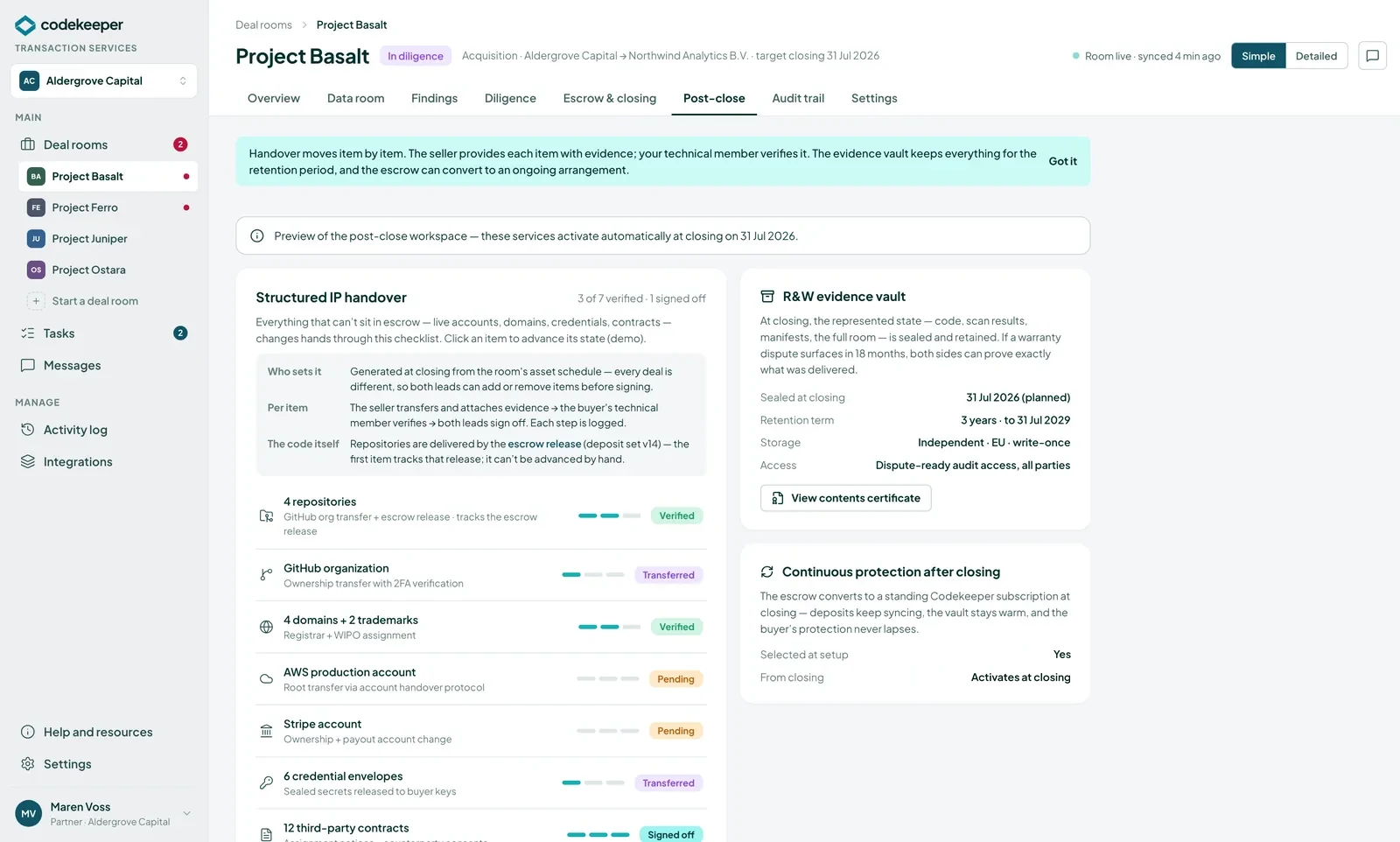
The sealed record of what was represented at closing is retained for three years. If a warranty claim arises, the evidence exists. In Professional and Complete engagements, the handover is then tracked item by item.
After closing
The 72 hours run from the moment the data room is ready to scan, not from the date of instruction. The seller is invited at no charge, and with guided onboarding a room is typically ready to scan in under a day. The expert report takes about two weeks. Remedies are data-backed negotiation support, not advisory.
Closing and handover.
On closing day a final full scan is run and both sides sign off. Everything the transaction transfers is then sealed into a single IP Package: the source code as it stood that day, the results of the final scan, the chain-of-title evidence, the license manifest and full software bill of materials (SBOM), the executed IP transfer agreements, and the asset schedules generated from the data room.
Codekeeper holds the package as a neutral third party, so that both sides know exactly what was transferred.
The asset inventory lists repositories, services, databases, infrastructure, domains, third-party dependencies and data flows. It becomes the schedule of transfer at closing, so that nothing is overlooked in the handover.
What cannot sit in escrow changes hands after closing through a structured handover. Every asset is transferred on a checklist: repositories, domains, credentials, cloud accounts and contracts. The seller transfers each item with evidence, your team verifies it, and both leads sign off. Every step is recorded.
The sealed closing snapshot is part of every engagement. The structured IP handover is included in Professional and Complete.
If you will run it yourself, have it rebuilt before you close.
Some transactions leave you to build and run the software without the people who wrote it: carve-outs and asset purchases, purchases out of insolvency, and products that rest on a few engineers or on code written by AI. In those transactions the first question of ownership is whether the software can be built at all once those people have gone.
For those transactions we have the deposit rebuilt before you close. AI agents take the deposited code into a sealed environment, work out how it is built, and build it. A run takes hours, where a manual build test takes weeks of specialist work, and it needs no help from the seller's engineers when the deposit is complete.
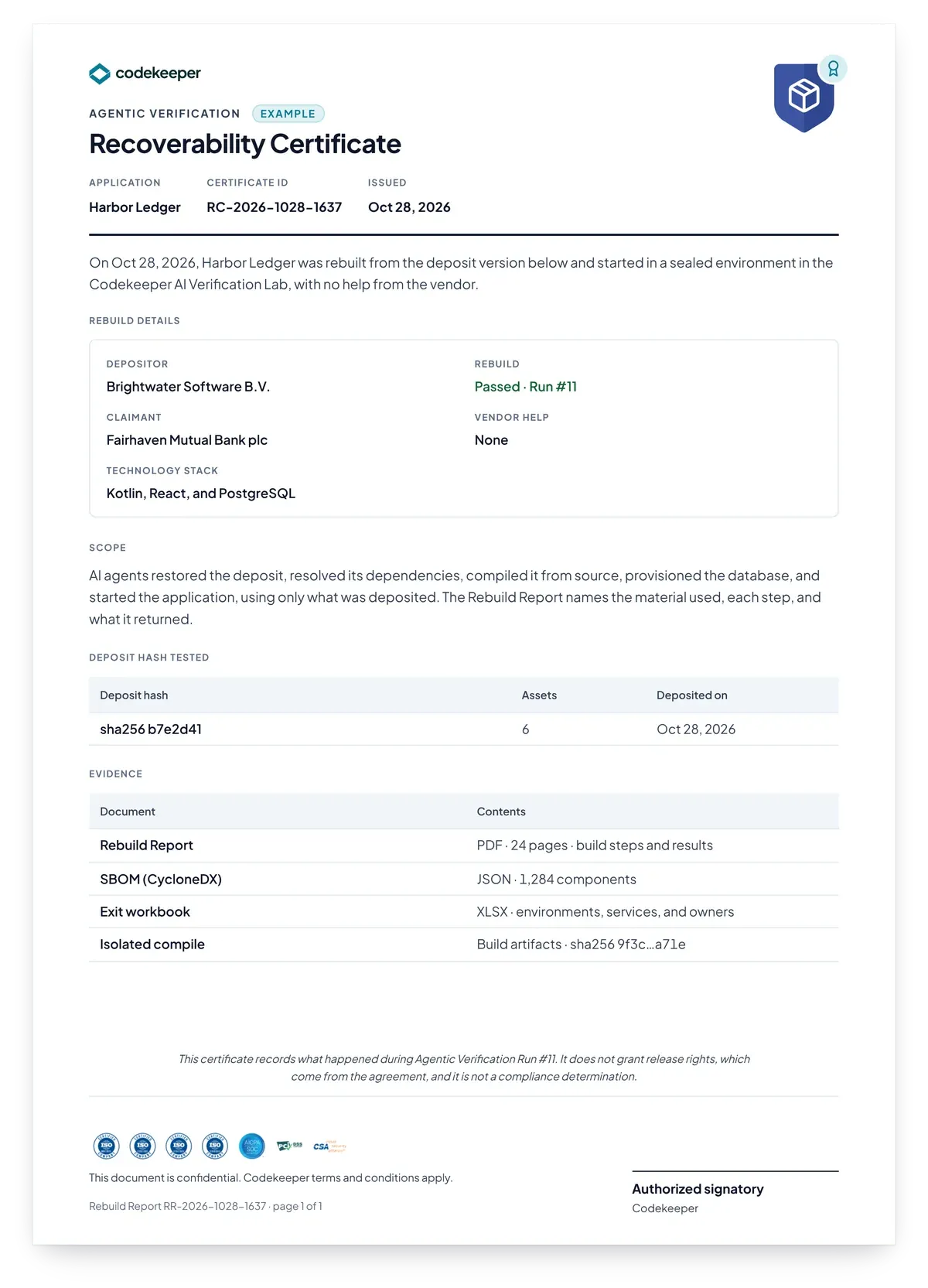
Each run produces a Rebuild Report. Where a run finds a gap, the report names it, the seller adds what is missing to the deposit, and the run is repeated, at a point when the seller can still put it right.
A run that passes adds a software bill of materials, a dated Recoverability Certificate and an exit workbook written from the run. The workbook sets out the recovery step by step: environment, deposit, build, configuration and checks. It gives your engineers a place to start once the software is theirs.
A run that passes shows that the software builds and starts. Agentic Verification is an addition to an engagement, on supported technology stacks. It runs on Codekeeper's own AI, in Codekeeper's environment, sealed off from the internet and from public AI models.
Which level of engagement fits your acquisition.
Professional is our standard engagement: the first report, then verification by our analysts. Essentials rests on the first report alone. In Complete, a senior expert leads the work.
Every level includes the technical data room, transaction escrow, the sealed closing snapshot and retention for three years.
Essentials
For SMB acquisitions and smaller rounds.
- Automated Scan Report in 72 hours
- IP chain-of-title and GenAI provenance analysis
- Transaction escrow, integrity-checked
- Sealed closing snapshot and 3-year retention
- 25 repositories / 750K lines of code included
Professional
The standard for investor due diligence and mid-market M&A, ready for an investment committee (IC).
- Everything in Essentials
- Analyst-Verified Report in about a week
- Issues paired with market-standard remedies
- Structured IP handover and the IP transfer agreement template pack
- 75 repositories / 2.5M lines of code included
Complete
A senior expert on the transaction, end to end. For platform acquisitions and contested valuations.
- Everything in Professional
- Expert Deep-Dive in about two weeks
- Architecture reviews and team interviews
- Scalability and roadmap-risk assessment
- 200 repositories / 10M lines of code included
Report delivery times are targets from the moment the room is ready to scan, not from the date of instruction. Included volume is fair use at each level, and larger estates add volume blocks.
Each level is a single fee per transaction. Fees
Once the software is yours.
The evidence is kept, and protection of the software continues. You now own the software, and the business you have acquired depends on software from other vendors as well. Codekeeper keeps both recoverable: when a vendor fails, the software is released to you, recovered for you, or kept switched on.
Evidence and escrow after closing- Evidence vault
- The sealed record of what was represented at closing is retained for three years, at every level of engagement. If a warranty claim arises, the evidence exists. Retention can be renewed after the third year.
- Continuous escrow protection
- Optional. The transaction escrow converts into a standing Codekeeper escrow subscription at closing, billed from closing. Codekeeper's Pro plans add Agentic Verification, up to four runs a year on supported technology stacks. Software escrow at Codekeeper
- Resilience
- If a vendor can no longer support the software, Codekeeper's engineers run the recovery for you, on a best-effort basis. Resilience at Codekeeper
- Continuity
- For software delivered as a service, Codekeeper keeps the service online while the recovery is worked on. Continuity at Codekeeper
The fee for renewing retention after the third year and the fee for continuous escrow protection are both published. Fees
You bring the deal. We bring the technology expertise.
Tell us about the acquisition and its timetable. We will set out the scope we would advise.