

For founders and CTOs
Your company, reviewed by engineers who have built their own.
Diligence sets the pace of your round or your exit, and it can reopen the price. Our job is to settle the technology question quickly and on evidence. The people who read your code have written code for a living, and what they find reaches you and the buyer in the same words, at the same moment.
- Invited sellers join at no charge
- The report the buyer reads
- Every access is recorded
Engineers and founders. We have been where you are.
The people who read your code have written code for a living. We have built products, run engineering teams and started companies, and we have sat through diligence as the company under review.

The people on your transaction are engineers.
Your company meets engineers. A first report comes from our technology, which reads the code and the contracts in the room. In our standard engagement an analyst then verifies the findings, removes the false positives, rates each risk in its context and writes the summary for the investment committee (IC).
On an expert engagement a senior expert leads the work: architecture review sessions, interviews with your team, and an assessment of scalability and roadmap risk. An expert engagement also has a dedicated deal manager. On other engagements, a working session with your engineers is an optional addition.
What it gives youYour answers to the findings are read by people who have built and run systems of their own.

What a good CTO would ask.
We know what a young company's code looks like the week before a launch. We can tell a deliberate shortcut from a problem that will cost money. So we ask what a good CTO would ask: who owns the code, who can still build and run it, what is exposed, and what it will cost to put right.
In the analyst-verified and expert reports, our analysts rate every risk in the context of your company's stage.
Why it mattersThe buyer hears about your code from people who can tell a deliberate shortcut from a real problem.
Evidence: SBOM entry · billing/package.json:41 · scan of 12 Aug, 09:14 UTC
- BuyerIs this dependency load-bearing, or can it be replaced before closing?
- Seller · Northlight SystemsReplaceable. The swap to an MIT-licensed alternative is scheduled this sprint. Will re-scan after merge.
The same report the buyer reads, and you can answer it.
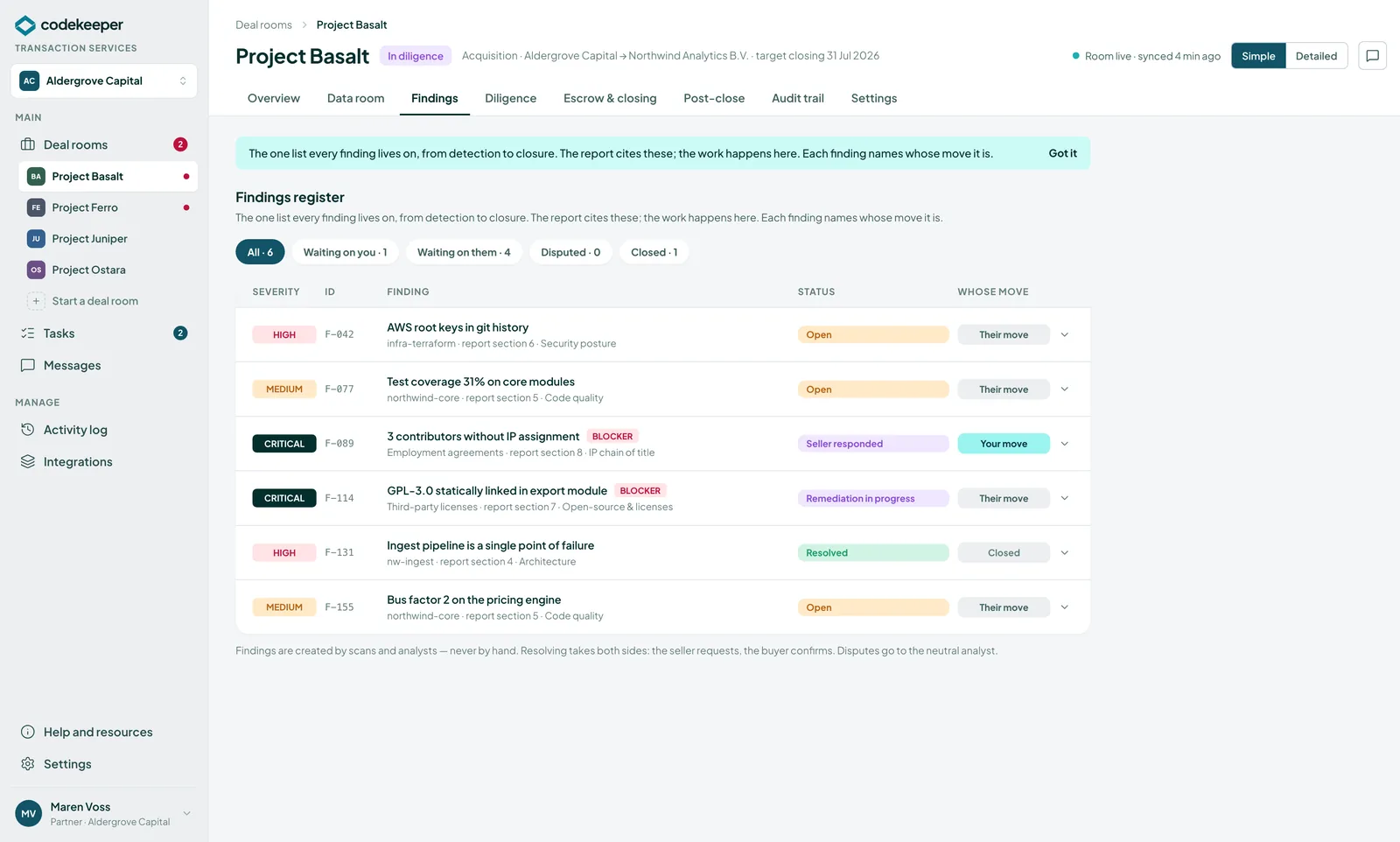
We report what we find to both sides in the same words. You see everything the buyer sees: the full report, at the same moment. Each finding is a fact linked to its evidence. It is not an opinion about your engineering.
You respond beside the finding. Your context, your disputes and your remediation plans sit in the thread with the evidence, and form part of the record the investment committee reads. When you remediate and sync, the next delta scan verifies the fix, and the finding closes with evidence before closing day.
One report. Both sides read it in the same words.
The report does not advocate for either side. There is no side channel, and no summary you cannot inspect.
It will not take your team out for a quarter.
The issues that derail software transactions are few and well known: who owns the code, who can still build and run it, what is exposed, and what it costs to fix. The evidence is in the code and the contracts. Our technology reads both, so the work takes days.
A first report.
Within 72 hours of the data room being ready.
Verified by our analysts.
Our analysts verify the findings, remove the false positives and write the summary for the committee.
Led by a senior expert.
For platform acquisitions and contested valuations. This is the engagement in which a senior expert interviews your team.
Your part
Your part is the data room. Guided onboarding takes you through it one asset type at a time. Connectors link git hosts, cloud and registries directly, and each item is validated before it counts as in the room.
A typical seller has a room ready to scan in under a day.
How an engagement runsWhat it costs you
One side instructs us and the other is invited. When a buyer invites you, you join by link, at no charge, and there are no seat fees.
Our fees are fixed and published.
FeesDelivery times are targets, counted from the moment the data room is ready to scan and not from the date of instruction.
As deep as you and the buyer agree.
How far a review goes is agreed between you and the buyer before it starts, and we go exactly that far. Our access to your repositories and infrastructure is read-only, and every access is recorded in the audit trail. There are three levels, and every section of the report states what was examined and what was not.
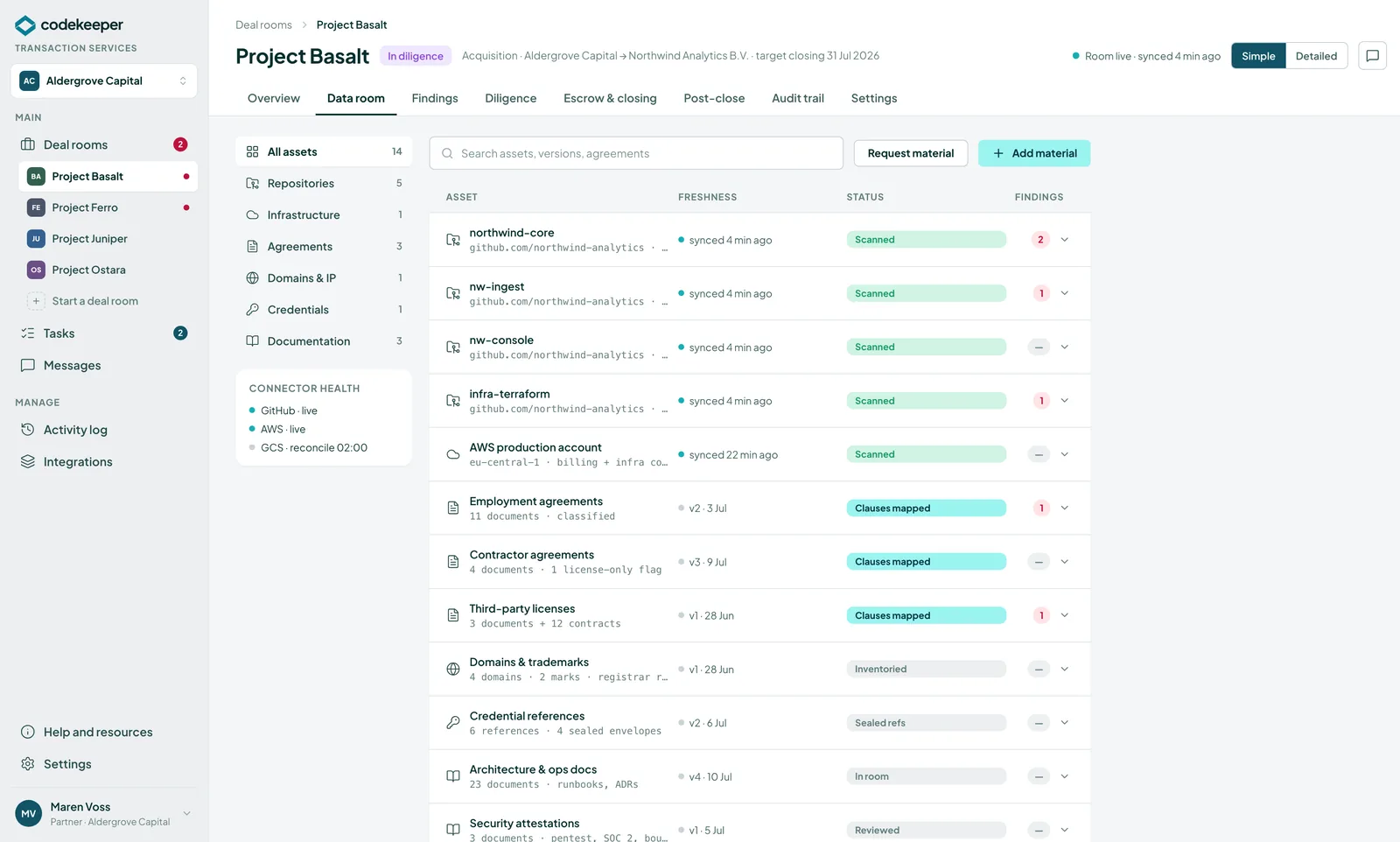
The documents and contracts in the data room.
You place agreements, licenses and documentation in the room. Agreements are parsed and classified on the way in, and each item is validated before it counts as in the room.
If you upload files and connect no sources, we scan what is in the room, and the report states its coverage: both sides see what was not examined.
What it gives youA review that stops where you and the buyer agreed, and a report that says so.

The repositories and infrastructure you connect to the room.
Connectors link git hosts, cloud and registries directly, and keep the room in step with your source platforms for the whole of the transaction. Every change is recorded as a new version and triggers a delta scan.
Code is cloned, built and scanned in sandboxes with no network egress.
What it gives youA fix you make during the transaction is verified by the next scan, and the finding closes with evidence.
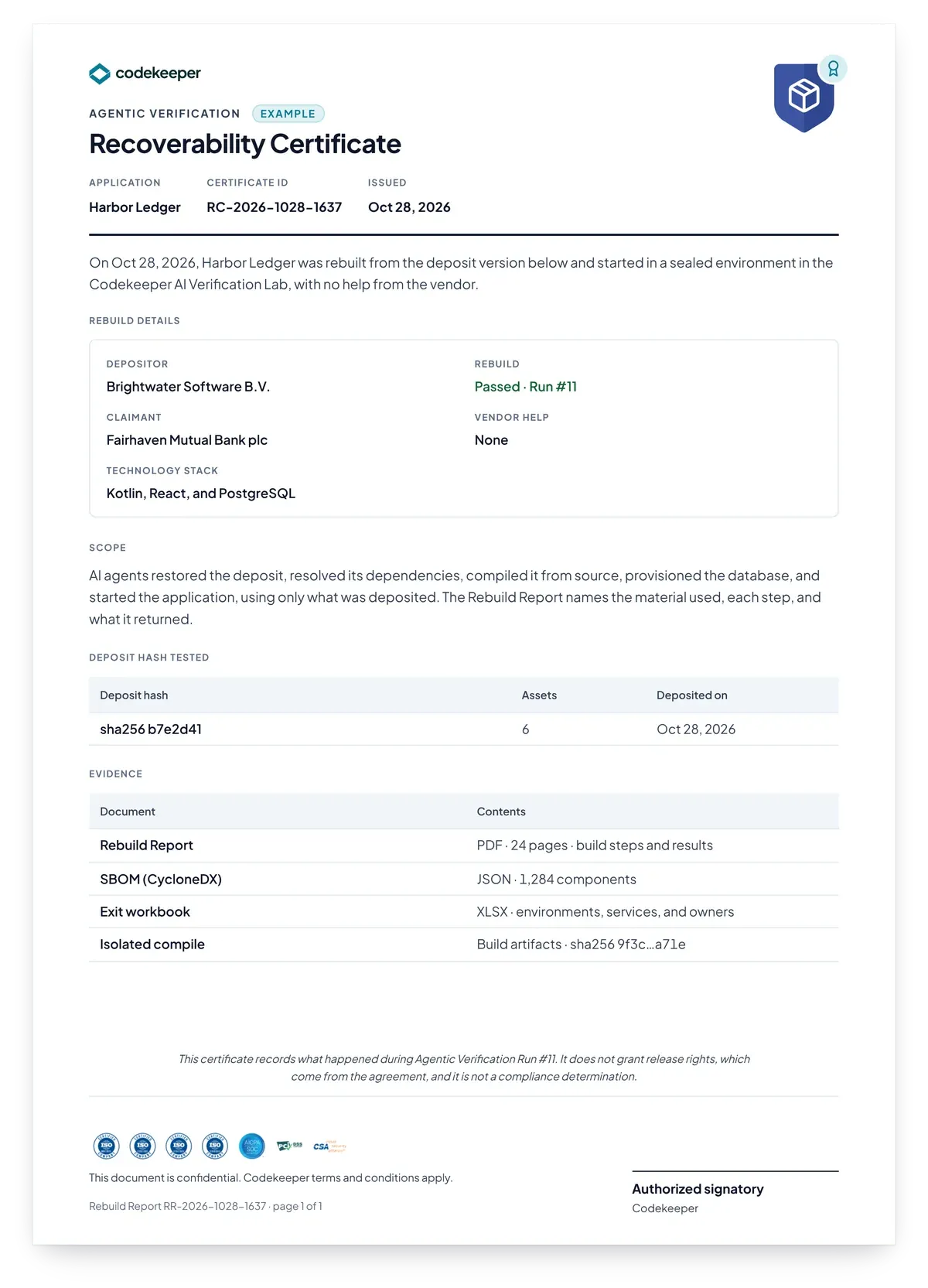
A full rebuild of the software, where the transaction calls for it.
In some transactions the buyer has to build and run the software without the people who wrote it. For those, AI agents take the deposited code into a sealed environment, work out how it is built, and build it. This is Agentic Verification, an addition to an engagement, on supported technology stacks.
What it gives youA run that passes issues a dated Recoverability Certificate.
The rebuild in detailThe confidentiality of your code.
All analysis runs in Codekeeper's private environment, in the region that holds the transaction. Your material is never sent to AI vendors and is never used for training.
Access is scoped per party and per stage: each party sees what its role and the stage of the transaction permit. Code is cloned, built and scanned in sandboxes with no network egress.
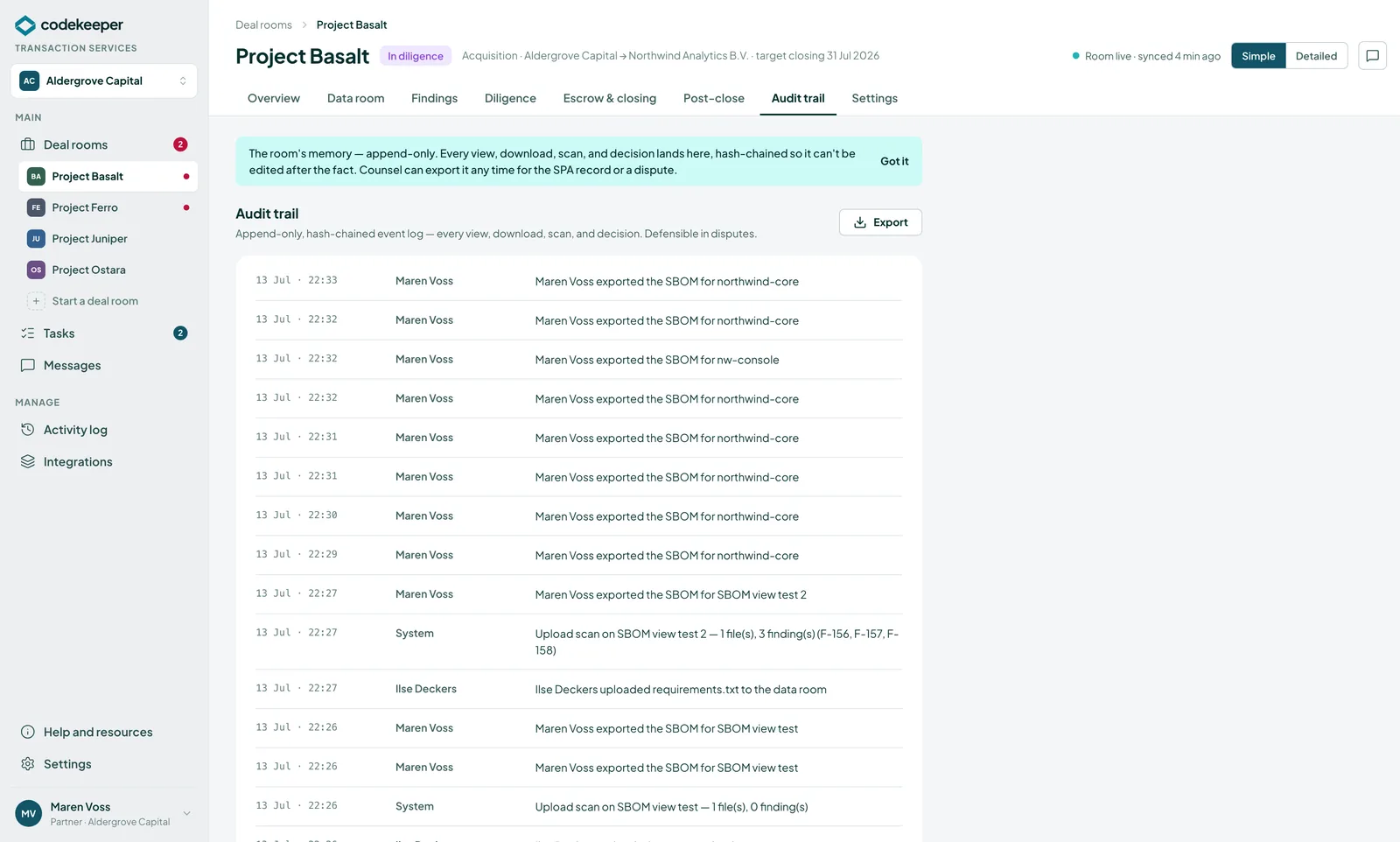
You see every access to your own material. Every view, download, sync, scan and sign-off is entered in an append-only audit trail that both sides can read. Access by Codekeeper's support staff to the materials of a transaction requires two people, and appears in your audit log.
Materials held in escrow are released only when every condition agreed for the transaction is met. No party can move them alone.
Codekeeper is ISO 27001 certified, and Transaction Services runs on the same information-security management system.
Better found early, while it is yours to fix.
Most software transactions close on management's account of the technology. Usually that holds. When it does not, the buyer's review finds what you had not looked at, and the cost lands on your side of the table in the last weeks before signing. The scene below is an illustration.

The question you could not answer.
The buyer's advisor finds a dependency you had forgotten and a contractor agreement that was never signed. The price is reopened in the last week, when you have the least room.
What a review showsThe same findings, months earlier, while they are still yours to fix.
Why an early answer counts.
An engagement runs in four steps: Find the risks, Price them, Close safely and Keep the evidence. In the second, the report prices the remedial work. In the analyst-verified and expert reports, each material finding is also paired with the market-standard contractual remedy: a holdback, a warranty, a condition precedent or a price adjustment.
The buyer's counsel drafts from that pairing, so an unanswered finding may become a remedy in the buyer's draft. A finding you have corrected or answered is read with your answer beside it.
The pairing of findings with remedies is data-backed negotiation support, not advisory.

Be ready for diligence before the term sheet arrives.
Deal-readiness is our standing arrangement, with a monthly fee, for a company that is not yet in a transaction. It gives you a data room that stays current, a readiness score that shows what is still missing, and a self-scan every quarter. You assemble the room in your own time.
The same readiness score serves you now and a buyer later. To you it is a list of what remains to be done. To a buyer it is a statement of coverage.
What it gives youThe self-scan lets you find and correct issues before an investor's diligence finds them.
Deal-readiness on the fee pageShow that your software builds without you.
In some transactions the buyer has to build and run the software without the people who wrote it: carve-outs and asset purchases, purchases out of insolvency, and products that depend on a few engineers or on code written by AI. For those transactions, Agentic Verification is the check within Find the risks. A run that passes is dated evidence that your deposit builds.
AI agents take the deposited code into a sealed environment, work out how it is built, and build it. When the deposit is complete, no help is needed from your engineers. A run takes hours, where a manual build test takes weeks of specialist work.
If a run finds a gap, for example a private package that is not in the deposit, the Rebuild Report names it. You add it to the deposit and the run is repeated.
Every run produces a Rebuild Report. A run that passes adds a software bill of materials (SBOM), an exit workbook and a dated Recoverability Certificate. The agents run on Codekeeper's own AI, in Codekeeper's environment, sealed off from the internet and from public AI models.
Within a transaction, Agentic Verification is an addition to an engagement. Outside a transaction, Codekeeper's Pro plans include it, up to four runs a year. Both apply on supported technology stacks. A run shows that the software builds and starts.
- Pre-flight checkStack matched
- Seal the environmentSealed
- Restore the depositRestored
- Work out the buildPackage missing
- Work out the buildDependencies resolved
- Isolated compileCompiled from source
- Start and checkHealth checks passed
Closing, and what follows.
Close safely and Keep the evidence are the last two steps. They leave one neutral record of what changed hands, so that both sides know exactly what was transferred.
-
The sealed IP Package
On closing day a final full scan is run and both sides sign off. Everything the transaction transfers is sealed into one package, held by Codekeeper as a neutral third party. Every party to the transaction can log in and see its status.
Escrow and the IP Package -
The handover
After closing, repositories, domains, credentials, cloud accounts and contracts are transferred item by item. You transfer with evidence, the buyer verifies, and both leads sign off.
After closing -
The evidence vault
The sealed record of what was represented at closing is retained for three years. If a warranty claim arises, the evidence exists.
-
Standing escrow
With continuous escrow protection, an optional addition to an engagement, the transaction escrow converts into a standing Codekeeper escrow at closing. Codekeeper also provides escrow for the customers who depend on your software.
Software escrow at Codekeeper
Questions founders put to us.
Does it cost me anything to join a buyer's transaction?
Who can see my code?
What if I only upload files instead of connecting sources?
Can I respond to findings?
How long before the buyer has a report?
Invited by a buyer, or preparing ahead.
The people across the table are dealmakers. We settle the technology question for both sides, on the same evidence. If a buyer has invited you, you join at no charge. If no transaction exists yet, we can discuss Deal-readiness with you, or you can instruct us from the fee page.