
Method and technology
Every finding is checked against the code.
Our technology reads the code, the infrastructure and the contracts directly from source, and links every finding to the material it came from. Diligence takes days, and both sides can open the evidence.
- Analysis in a private environment
- Nothing sent to AI vendors
- ISO 27001 certified
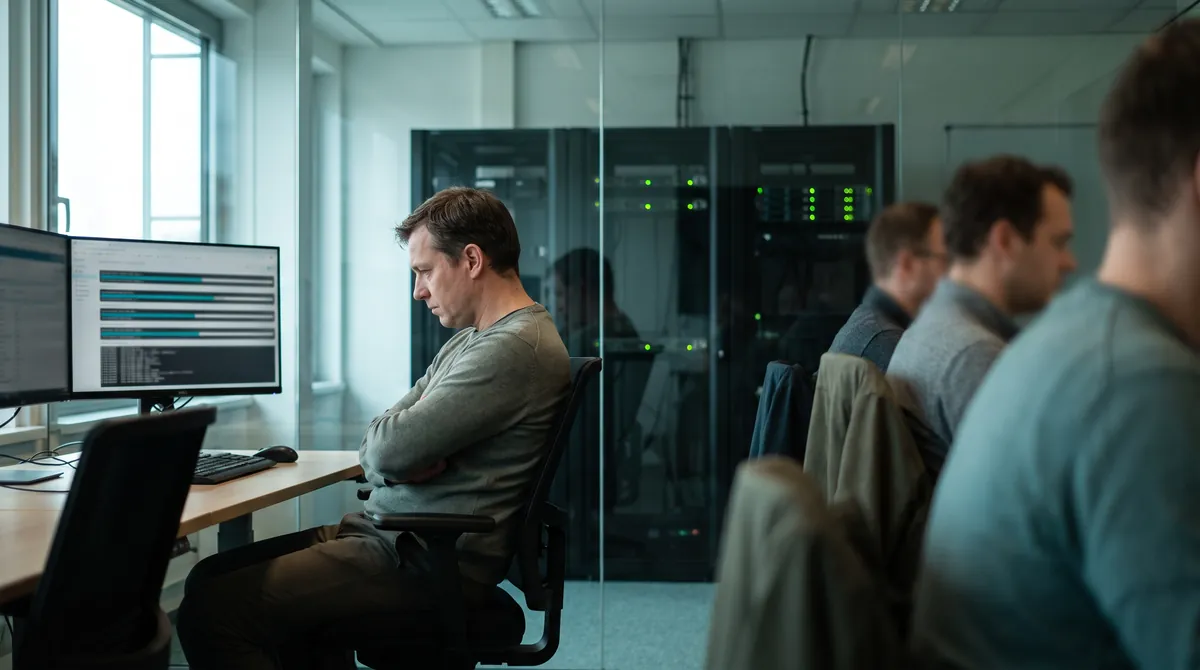
The technology, on film.
How the room is read.
The seller connects repositories, infrastructure and contracts to a data room that stays in step with their systems, and our analysis reads what is there. This is what it reads, and what each part gives you.
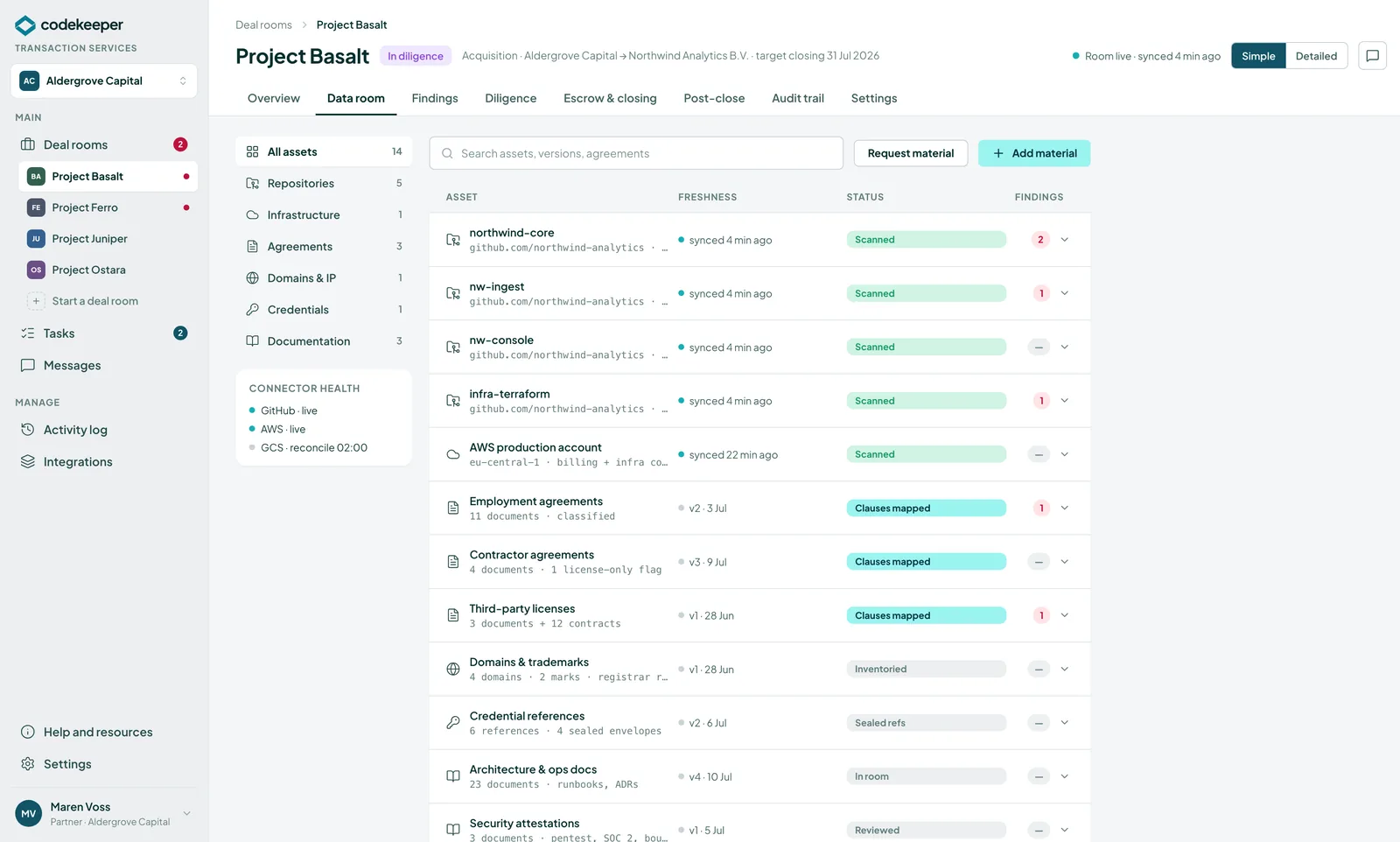
The room stays in step with the seller's systems.
Connectors keep the room synchronized with the source platforms for the whole of the transaction. Every change is recorded as a new immutable version and triggers a delta scan.
What it gives youA first report within 72 hours of the data room being ready. Each report records the exact state of the room it was generated against, and can be regenerated against the room as it stands, up to closing.
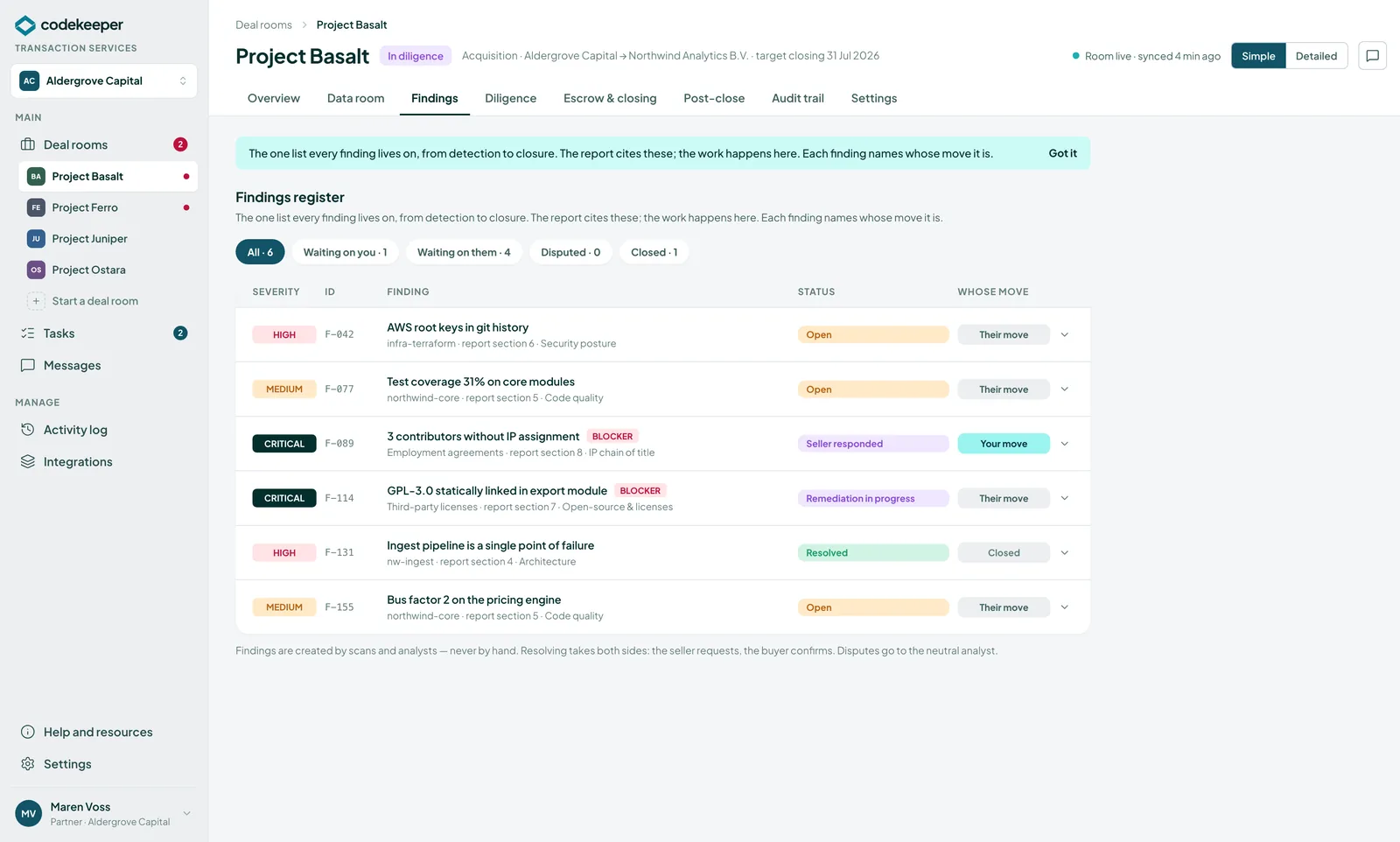
Ownership is read from the contracts and from the code history.
Our analysis reads every agreement in the room, maps each clause that assigns intellectual property, and cross-checks that coverage against the contributors in the code history. The result is a chain-of-title score and a list of gaps.
Software composition analysis and license compliance come with a full software bill of materials (SBOM). The license inventory shows copyleft contamination paths.
What it gives youWho owns the code, and which licenses come with it, set out before you sign. Every finding links to the source clause. This is analysis, not legal advice.
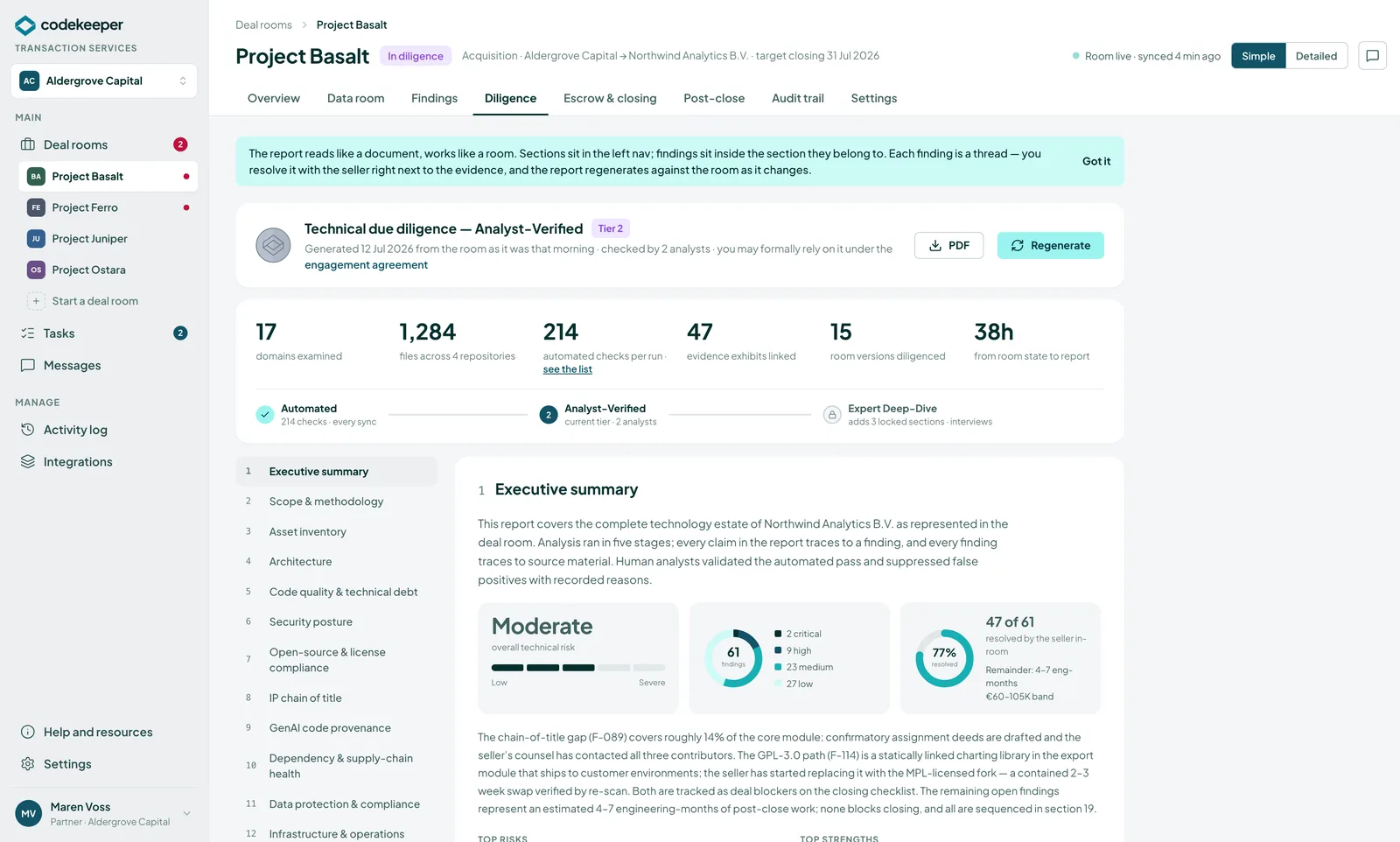
Security, architecture and the quality of the code.
Static analysis (SAST), secrets in the code and in its git history, and known vulnerabilities (CVEs) from the SBOM. The report also covers exposure to dependency confusion, authentication patterns and the use of encryption.
An architecture map shows the service topology and the single points of failure. The code-quality metrics cover complexity, duplication, test coverage and debt hotspots. Every report also estimates the share of the codebase generated by AI, its concentration by module, and the implications for intellectual property and security that follow.
What it gives youWhat is exposed, and what it costs to fix. The report prices the remedial work in engineer-months and as a cost band.
The contents of the reportEvidenceSBOM entry · billing/package.json:41 · scan of 12 Aug, 09:14 UTC
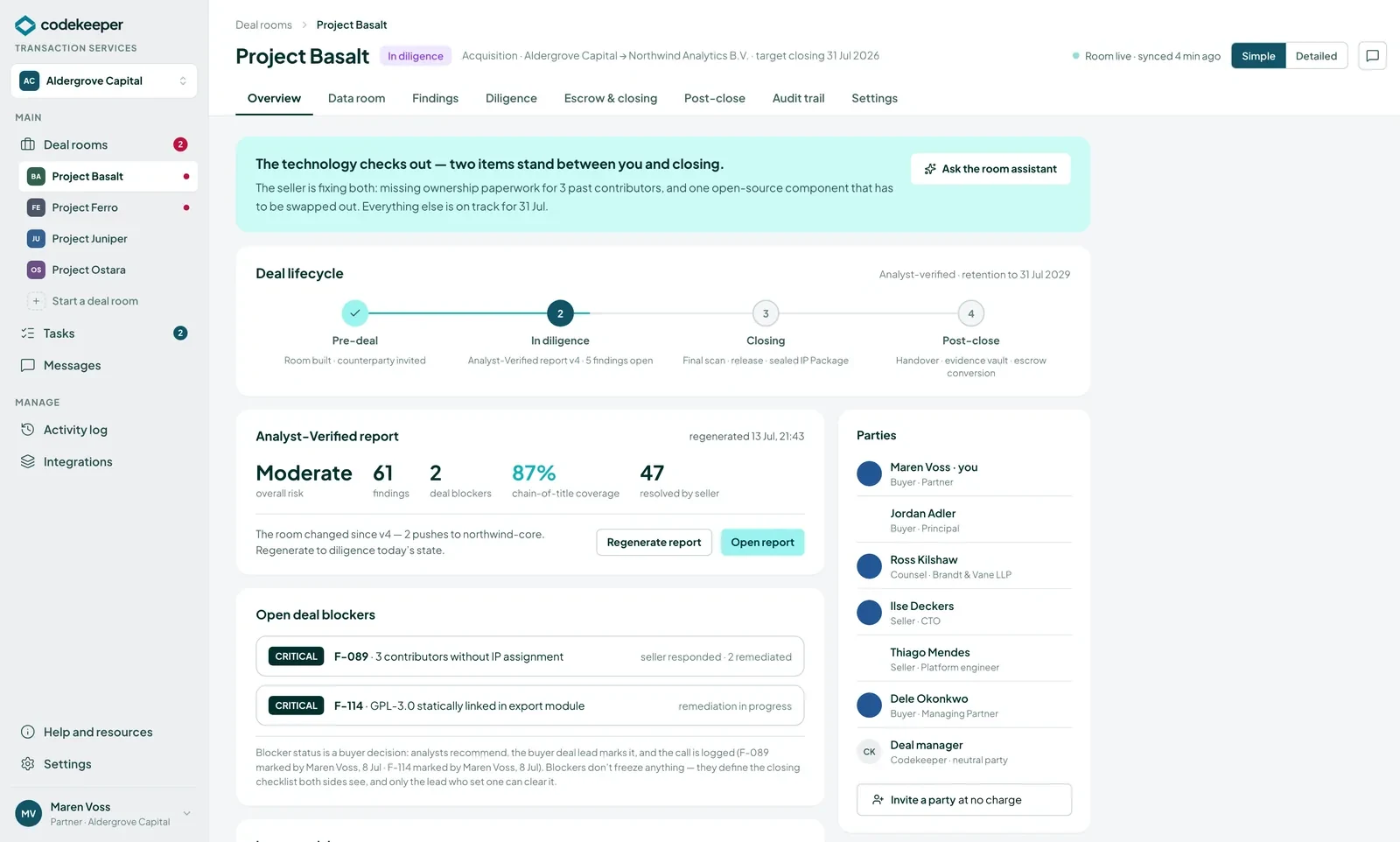
Aldergrove CapitalIs this dependency load-bearing, or can it be replaced before closing?
Northlight SystemsReplaceable. A swap to an MIT-licensed alternative is scheduled this sprint. Will re-scan after merge.
Every finding opens its source.
Each finding is established from the code and the contracts themselves, and arrives with its evidence, so that you can trace it yourself. Every statement in the report cites a finding, and every finding opens the source material in the room. Each section of the report states what was examined and what was not.
The seller responds on the record, in the thread on the finding, and both sides read the same report.
What it gives youEvidence the other side can open and check, so that the negotiation is argued on facts.
Formal reliance is a separate matter. Reports are informational by default. On the analyst-verified and expert engagements, named parties can obtain a reliance letter, with a liability cap of 3× fees. Reliance letters and insured coverage
The reading is automated. The judgment is not.
The people who weigh the findings have written code for a living. In the analyst-verified and expert reports, an analyst verifies the findings, removes the false positives and rates each risk in the context of the company's stage.
Our technology reads as far as the parties agree.
The depth of a review is agreed between the parties before it starts, and we go exactly that far. Our access to repositories and infrastructure is read-only, and every access is recorded in the audit trail. Our technology reads what the parties have placed in the room or connected to it, and every section of the report states what was examined and what was not.

The documents and contracts in the data room.
Each item is checked for format, completeness and readability when it is uploaded, and counts as in the room only once it has passed. Agreements are parsed and classified on the way in.
Where a seller uploads files in place of connecting sources, we scan what is in the room, and the report states what was not examined.
Why it mattersThe reader sees how far the review went. The coverage is stated in the report itself.

The repositories and infrastructure connected to the room.
Connectors link git hosts, cloud providers and package registries directly. On the way in, repositories are fingerprinted and manifests are extracted, so that every scanner works from clean input.
Why it mattersEach party sees what its role and the stage of the transaction permit. Every view, download, sync, scan and sign-off is entered in an audit trail, and the seller sees every access to its own material.

A full rebuild of the software, where the transaction calls for it.
Where the buyer has to build and run the software without the people who wrote it, the parties can agree to go one step further: a full rebuild of the software with Agentic Verification, on supported technology stacks.
What it gives youA pass records that the deposit built and started, and when.
How the rebuild is carried outWhere it runs.
Unreleased code is confidential, and so is the existence of the transaction. All analysis runs in Codekeeper's private environment, in the region that holds the transaction.
The region is chosen when the transaction is opened. All handling of code, whether cloning, building or scanning, takes place in ephemeral micro-VMs with no network egress. Where an engagement includes a rebuild of the software, that too runs within Codekeeper's environment.
Codekeeper is ISO 27001 certified, and Transaction Services runs on the same information-security management system.
What it gives youThe materials of a transaction are never sent to AI vendors and are never used for training.
Regions for analysis
- European UnionAmsterdamLive
- United StatesVirginiaLive
- United Kingdom and other regionsProvisioned per transactionOn request
When a transaction calls for it: rebuilding the software.
In a carve-out or an asset purchase, in a purchase out of insolvency, or where a product rests on a few engineers or on code written by AI, the buyer has to build and run the software without the people who wrote it.
For those transactions, AI agents take the deposited code into a sealed environment, work out how it is built, and build it. Agentic Verification shows that the software can be built again from what was deposited. No help is needed from the seller's engineers when the deposit is complete.
Pre-flight check
The agents read the deposit and match each part to a supported technology stack.
Seal the environment
A clean environment opens in the Codekeeper AI Verification Lab, for this run only.
Restore the deposit
Repositories and documents come back as deposited.
Work out the build
The agents study how the software is built and resolve its dependencies, private packages included.
Isolated compile
The software is compiled from source, inside the sealed environment.
Start and check
Services start, and health checks confirm that the application runs.
Write the evidence
Every run ends with a Rebuild Report. A run that passes adds the rest of the evidence set.
A typical run. The exact steps depend on the technology stack. A run takes hours, where a manual build test takes weeks of specialist work.
What a run produces.
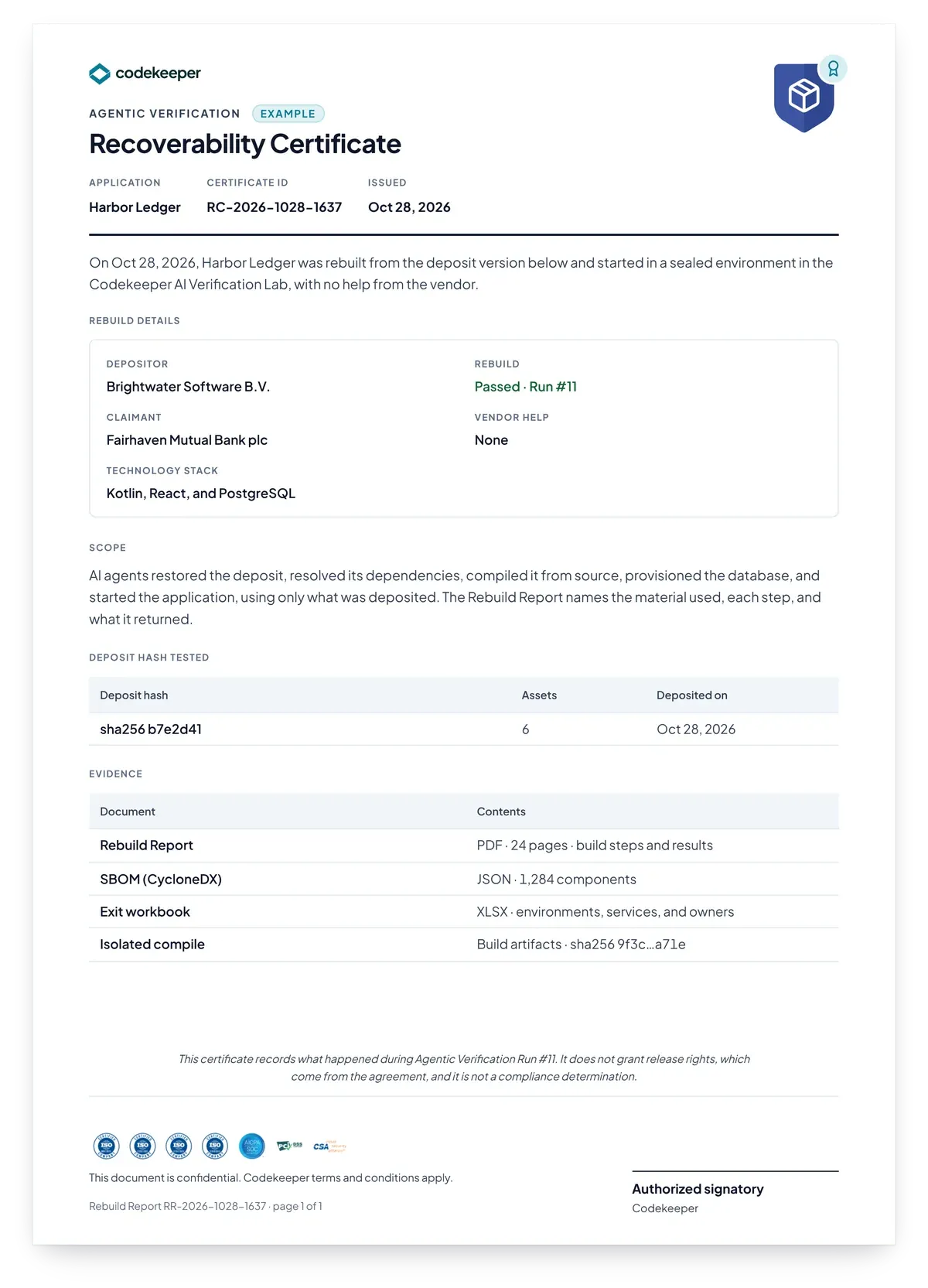
Every run produces a Rebuild Report. A run that passes adds a software bill of materials, an exit workbook and a dated Recoverability Certificate.
- Rebuild Report
- Each step the agents took, what compiled, and anything that was missing.
- Recoverability Certificate
- The application, the result and the date, on one page.
- Software bill of materials
- Every component the build used, direct and transitive, with versions and licenses, in CycloneDX.
- Exit workbook
- The recovery, step by step, written from the run: environment, deposit, build, configuration and checks.
A pass records that the deposit built and started, and when. The Recoverability Certificate is not a compliance certificate.
Practical matters.
What follows when a run does not pass, how each run is kept apart, and how the work is engaged.
Where a run finds a gap
A run that does not pass still shows how far the build got and what was missing. The Rebuild Report names the gap, the seller adds what is missing to the deposit, and the run is repeated. A gap found before closing is one the seller can still put right.
How each run is sealed off
The agents run on Codekeeper's own models, in Codekeeper's environment. Each run has a sealed environment of its own, which holds the deposit, Codekeeper's AI agents and Codekeeper's own models. It has no connection to production systems, development systems, the open internet or public AI models.
How it is engaged
Agentic Verification is an addition to an engagement, on supported technology stacks. Our fees are fixed and published. Fees
To establish whether a target's technology stack is supported, discuss the transaction with us.
What happens to the results.
The remaining three parts of an engagement take over from here. The remedial work is priced, the findings are sealed at closing, and they are kept as evidence afterwards.
The remedial work is priced.
The report prices the remedial work in engineer-months and as a cost band. In the analyst-verified and expert reports, each material issue is paired with the remedy the market would expect, and the work is sequenced into a plan for the first hundred days.
What it gives youA figure that can enter your valuation, and remedies to take into the negotiation. Remedies are data-backed negotiation support, not advisory.
Cost, remedies and the plan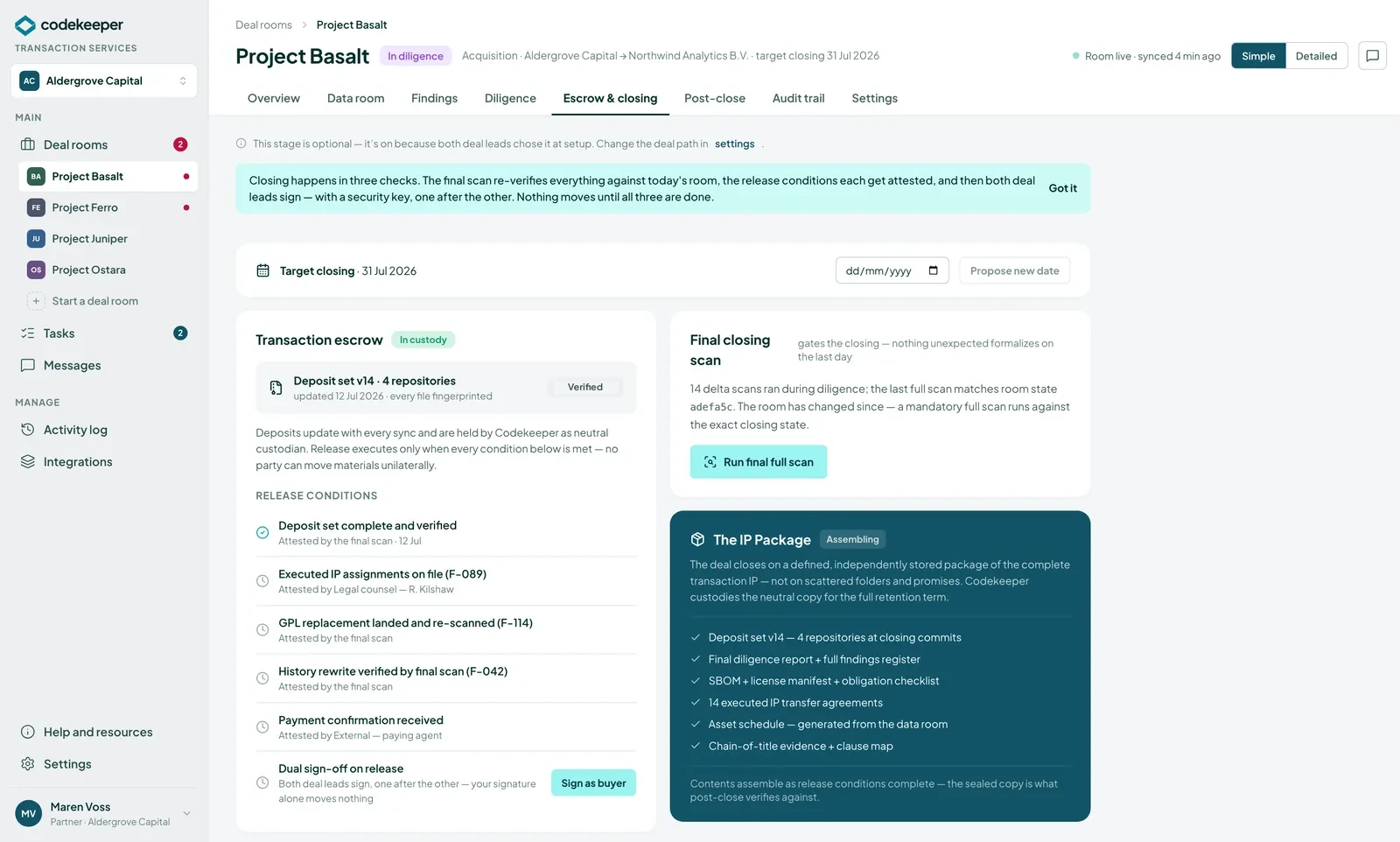
The results are sealed at closing.
On closing day a mandatory full scan is run and both sides sign off. The final scan results, the findings register, the chain-of-title evidence and the full SBOM are sealed with the source code into a single IP Package, which Codekeeper holds as a neutral third party for the full retention term.
Why it mattersWhat both sides signed off is held in one package, by a neutral third party.
Escrow and the IP Package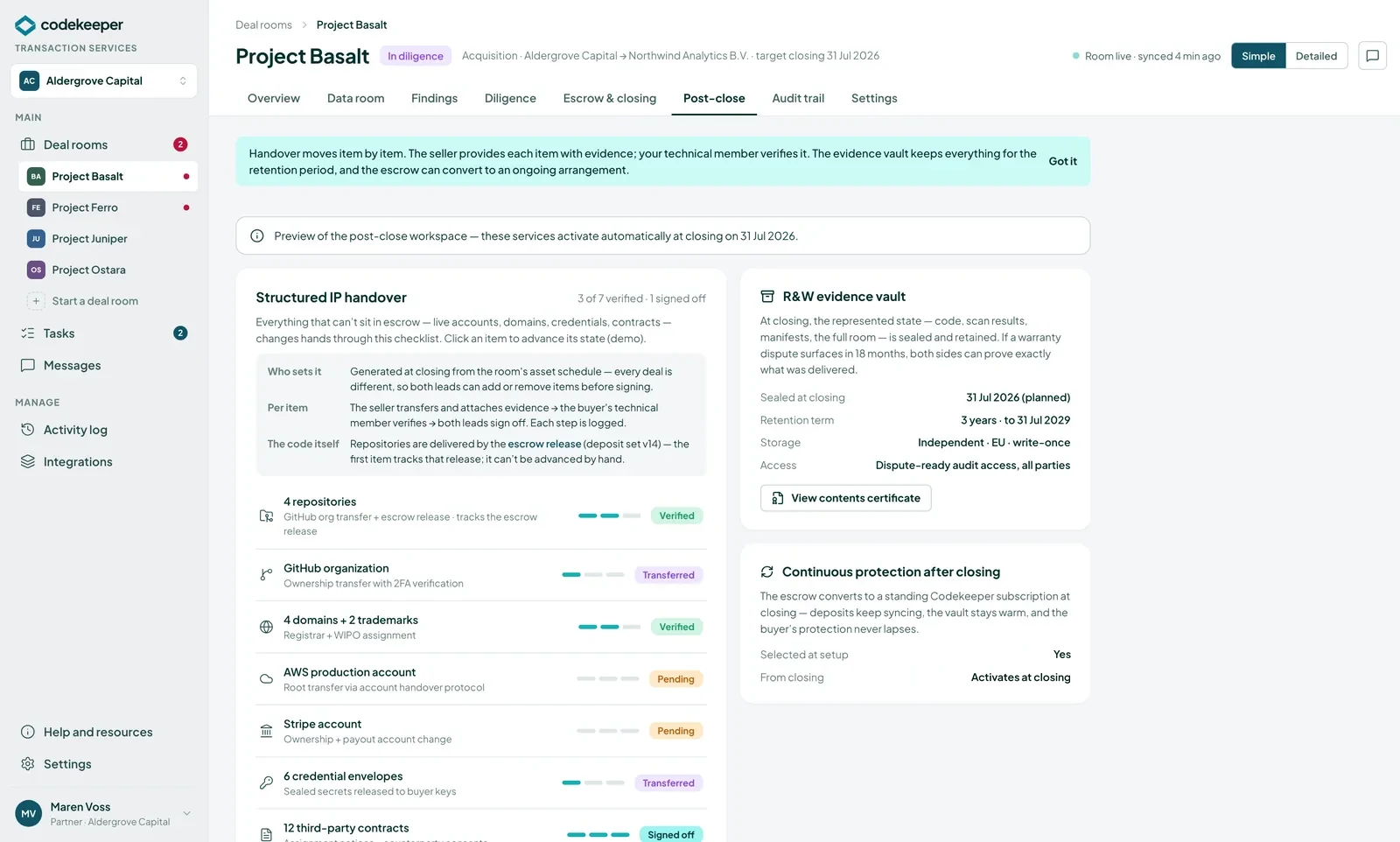
The record is kept for three years.
The sealed record of what was represented at closing is retained for three years. With continuous escrow protection, the transaction escrow converts into a standing Codekeeper escrow at closing. Codekeeper Pro plans include Agentic Verification, up to four runs a year, on supported technology stacks.
Why it mattersIf a warranty claim arises, the evidence exists.
After closingDealmaking is your craft. The technology is ours.
Tell us about the transaction and its timetable. We will set out the scope we would advise, and whether a rebuild of the software belongs in it.