

For advisors and counsel
A neutral room for both sides of a transaction.
You are the dealmakers who get your clients to signing. The technology question should not hold up the timetable. When you direct a client to a process for it, that process has to be neutral and documented: one room for buyer and seller, one report that both read, release on the conditions agreed for the transaction, and a record of every action that counsel can export.
- The counterparty joins at no charge
- Fixed, published fees
- ISO 27001 certified
What your client gains, and what you draft from.
An engagement does three things for a transaction. For counsel and for corporate finance advisors, the weight falls on the second and the third: remedies that rest on evidence, and the terms on which other parties may rely on the report.
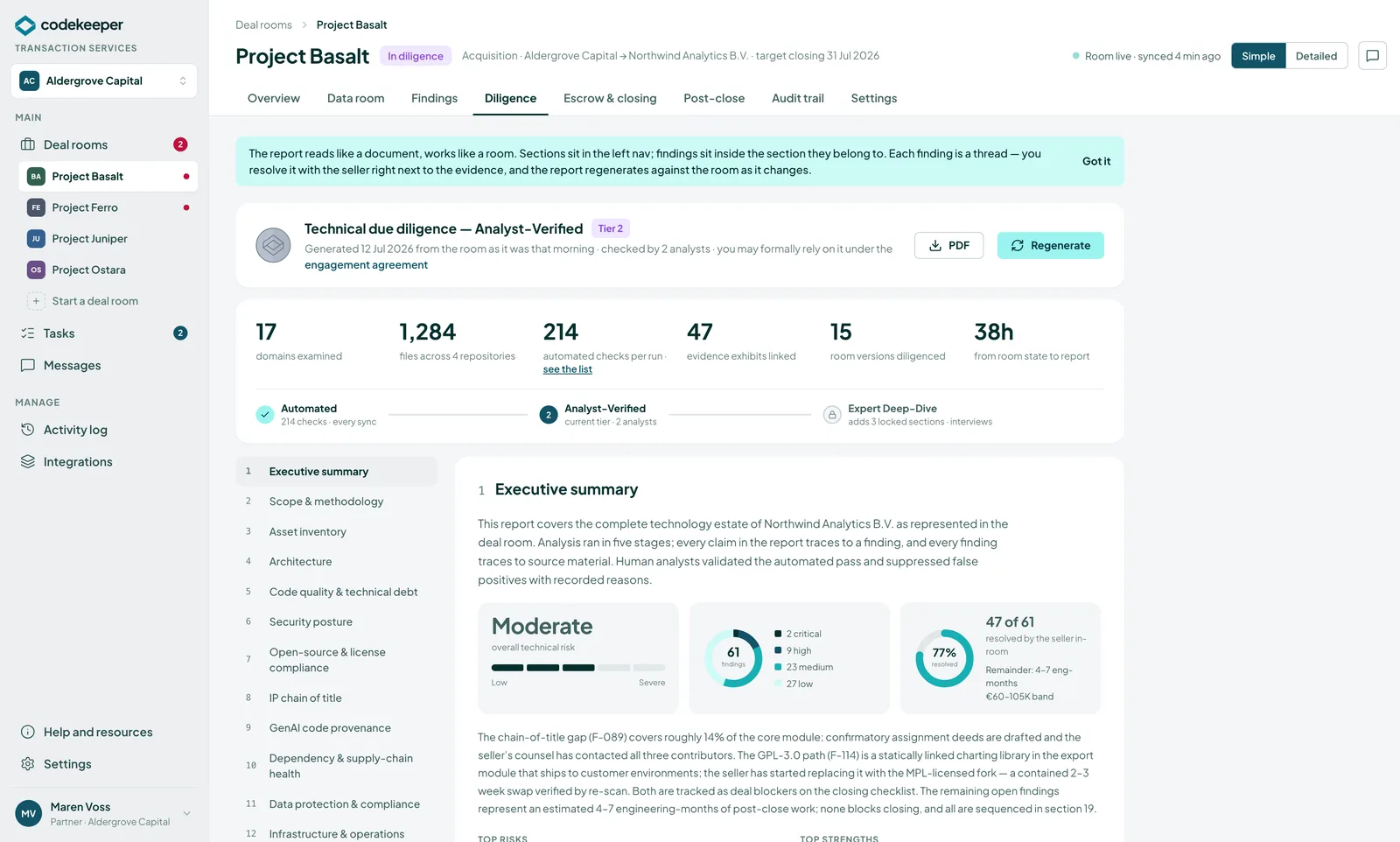
De-risk the deal.
Page one says whether anything should stop the transaction: the overall risk rating, the principal risks and any deal blockers. Each statement in the report cites a finding, and each finding opens the source material in the room. Every section states what was examined and what was not.
Ownership is checked against the code. We read every agreement in the room, map each clause that assigns intellectual property, and check the coverage against the list of contributors in the code history. As an optional addition, an in-house analyst validates the IP clause findings into an issue list ready for counsel.
Analysis, not legal advice. Every finding links to the source clause.
What it gives youA chain of title you can test before signing: each assignment compared with the people who wrote the code.

Negotiate on facts.
The report prices the remedial work in engineer-months and as a cost band. In the analyst-verified and expert reports, each material finding is paired with the market-standard contractual remedy: a holdback, a warranty, a condition precedent or a price adjustment. Counsel drafts from the data.
Data-backed negotiation support, not advisory.
What it gives youYou argue from evidence the other side can open and check.
Cost, remedies and the plan
Reliance, on published terms.
The report is written for an investment committee, with every statement linked to its source, so that a lender's or co-investor's advisor can follow each finding to the evidence.
Reports are informational by default. On the analyst-verified and expert engagements, named parties can obtain a reliance letter, with a liability cap of 3× fees. Insured coverage raises the cap to €1M or €5M. Fees for insured coverage are indicative pending professional-indemnity insurance placement.
Why it mattersThe terms on which a named party may rely on the report are set out below, each with its cap.
Reliance and liabilityReliance and liability.
Reports are informational by default. On the analyst-verified and expert engagements, named parties can obtain reliance letters with a liability cap of 3× fees, and insured coverage raises the cap to €1M or €5M, backed by professional indemnity (PI) insurance.
| Level | What it carries | Reliance and liability |
|---|---|---|
| Informational | The standard report terms. Included in every engagement. | No formal reliance |
| Reliance letter | A letter for a named relying party, one for each relying party. Available on the analyst-verified and expert engagements. | Liability cap of 3× fees |
| Insured, €1M cap | For named relying parties. The cap is backed by professional indemnity insurance. | Liability cap of €1M |
| Insured, €5M cap | For named relying parties. The cap is backed by professional indemnity insurance. | Liability cap of €5M |
Fees for insured coverage are indicative pending professional-indemnity insurance placement. Confirmed fees are published before the coverage is offered. The fee for each level is set out under Fees.
The same facts, in the same words, to both sides.
Codekeeper has spent a decade as the trusted third party between software counterparties. Transaction Services takes the same position within a transaction: the report does not advocate.
The people who read the code have written code for a living. We have built products, run engineering teams and started companies, and we have sat through diligence as the company under review. The company under review meets engineers who ask what a good CTO would ask, and both sides receive the same findings.
The seller sees everything the buyer sees: the full report, at the same moment. There is no side channel, and no summary the seller cannot inspect. The seller's context, disputes and remediation plans sit in the thread beside each finding, and form part of the record that the buyer's investment committee (IC) reads.

What the room gives advisors and counsel.
These arrangements are part of every engagement. They answer the questions advisors and counsel put to us first: who sees what, what record remains afterwards, and how the materials are released.
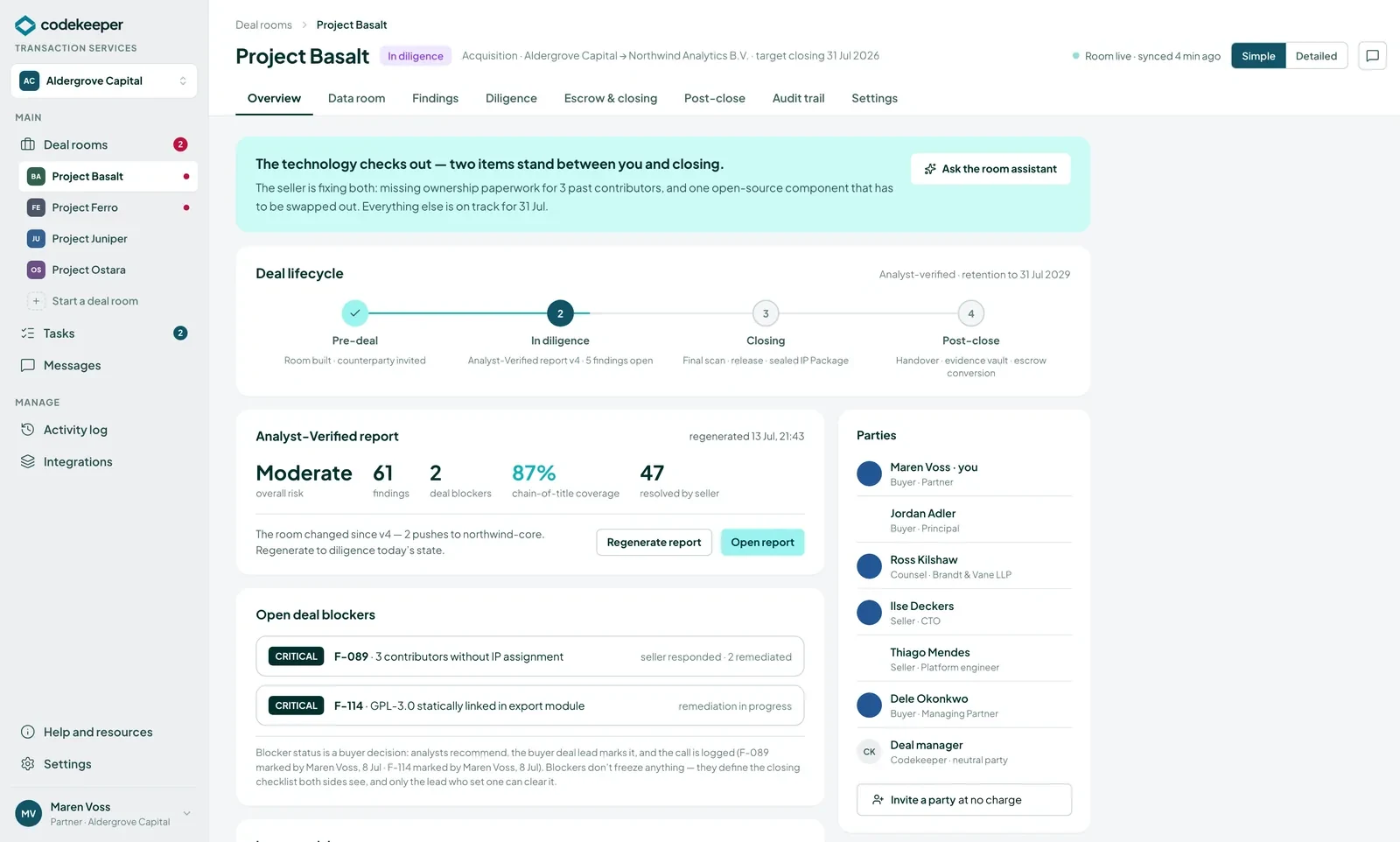
Access by role.
Access is scoped per party and per stage of the transaction. Counsel, advisors and investors each join in their own role and see what that role permits.
What it gives youData processing agreements (DPAs) and our security review pack are available for your own review before your client commits.
How an engagement runs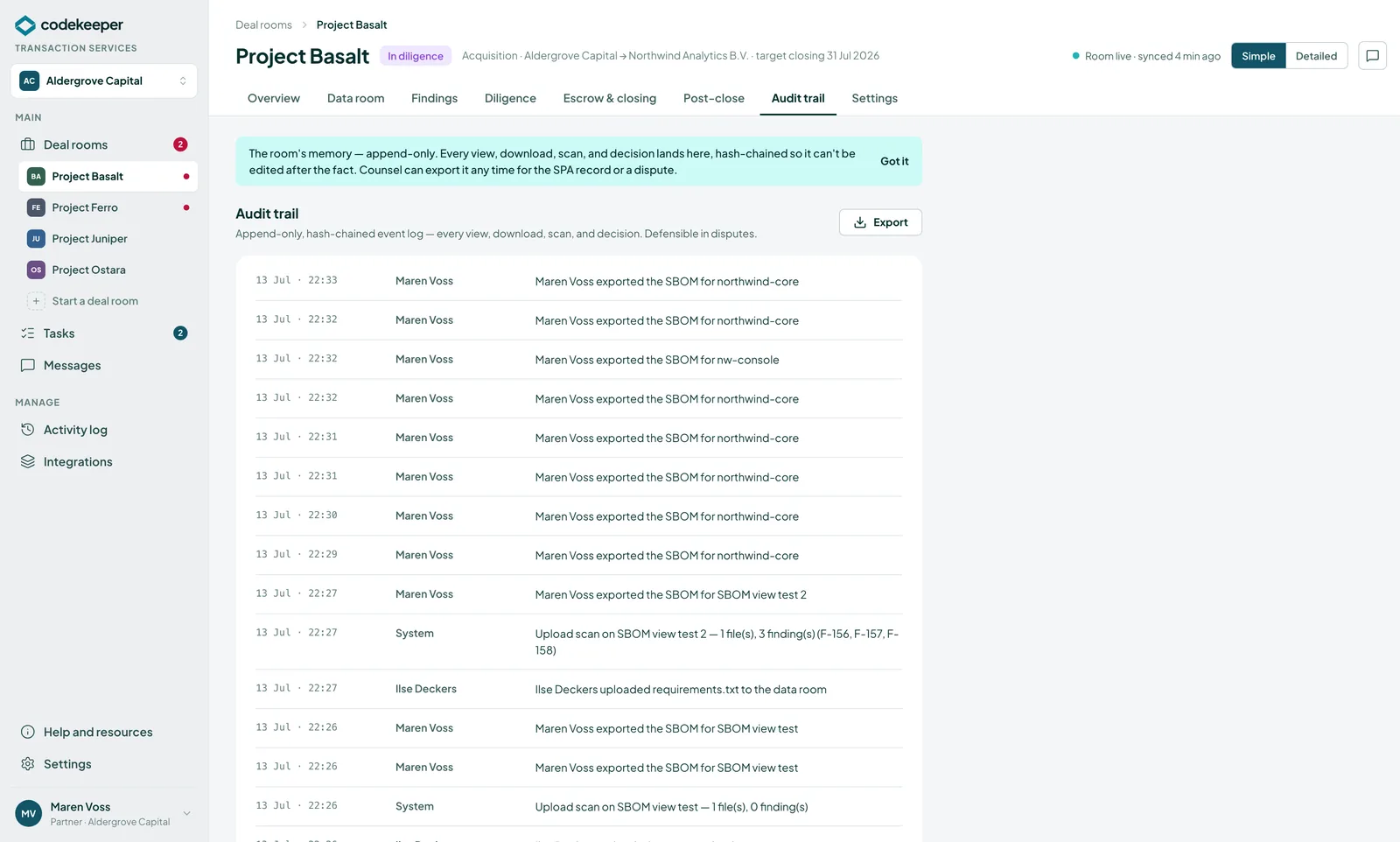
The audit trail.
Each transaction carries an append-only, hash-chained log of every view, download, sync, scan and sign-off. Counsel can export it, and disputes can rely on it.
The record is open to both sides in the same way. Our own support access to the materials of a transaction requires two people, and appears in the same log.
Security and the audit trail
Transfer agreement templates.
Transfer and assignment templates, specific to the jurisdiction and linked in advance to the asset inventory of the transaction, so that the schedule of transferred assets is generated from the data room. They are included in the Professional and Complete levels of engagement, and optional with Essentials.
Templates are drafted and validated by qualified counsel per jurisdiction. Analysis, not legal advice.
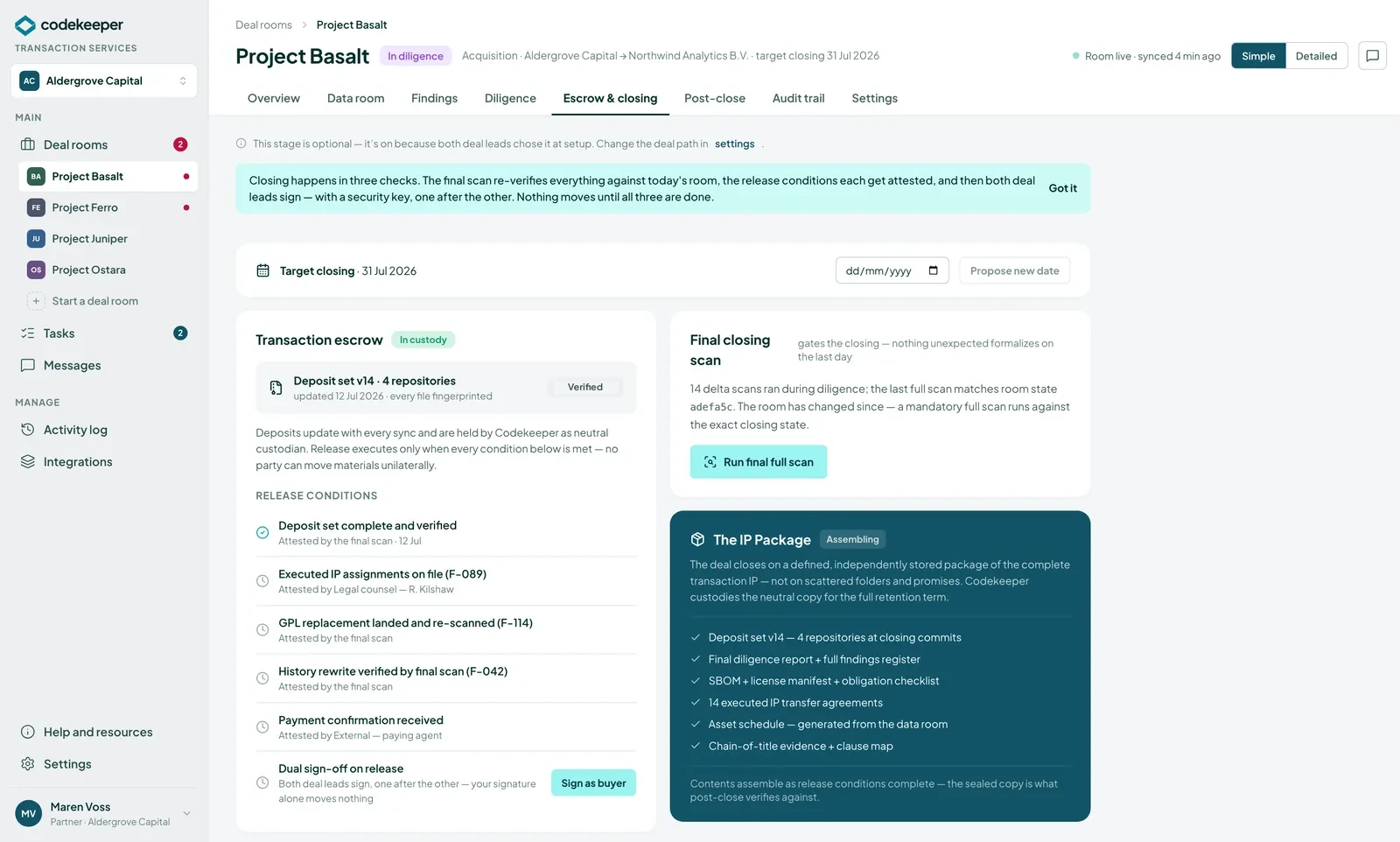
Release only on the agreed conditions.
The materials of the transaction are held in neutral custody. Release takes place only when every condition is met, and no party can move the materials alone.
At closing a mandatory full scan is run, both sides sign off, and the IP Package is sealed. Codekeeper holds it as a neutral third party for the full retention term, and every party to the transaction can see its status.
Why it mattersBoth sides know exactly what was transferred.
The conditions of release.
Release conditions are configured for each transaction, and each names the party who attests to it.
The form of the condition is chosen to suit the transaction: confirmation of closing, sign-off by both sides, or an agreed date.
- Closing confirmationRelease is executed when the transaction formally closes, confirmed in the application by the parties named in the release configuration.
- Dual sign-offBoth sides, or counsel on each side, sign off before anything moves. Release ceremonies use step-up authentication and dual control.
- Date-basedFor staged transactions and earn-outs. The materials are released automatically on the agreed date unless the conditions change.
The four steps of an engagement.
A typical seller has a data room ready to scan in under a day, with guided onboarding. A first report follows within 72 hours of that moment, so the interval from instruction to first report is usually 3 to 4 days. Verification by our analysts adds about a week.
-
Find the risks
Both sides negotiate from the same report. Every finding is checked against the code and the contracts and is linked to its evidence, and deal blockers are flagged on the first page. The report is brought up to date against the data room until closing.
Technical due diligence -
Price them
The report prices the remedial work in engineer-months and as a cost band. In the analyst-verified and expert reports, each material finding is paired with the market-standard remedy, so that counsel drafts the purchase agreement from evidence.
Cost, remedies and the plan -
Close safely
Each release condition names the party who attests to it. At closing a final full scan is run, both sides sign off, and the IP Package is sealed, so that both sides know exactly what was transferred.
Escrow and closing -
Keep the evidence
The sealed record of what was represented at closing is retained for three years. If a warranty claim arises, the evidence exists.
After closing
The 72 hours run from the moment the data room is ready to scan, and not from the date of instruction. Remedies are data-backed negotiation support, not advisory.
Where the software must be built without the people who wrote it.
In a carve-out or an asset purchase, in a purchase out of insolvency, or where a product depends on a few engineers or on code written by AI, the buyer has to build and run the software without its authors. For those transactions, Agentic Verification is an addition to an engagement, on supported technology stacks.
AI agents build the deposited code in a sealed environment, in hours, and the run shows that the software builds and starts. A run that passes issues a dated Recoverability Certificate, which records that the deposit built, and when. Whether that supports a particular representation is for the parties and their counsel to decide.
Fees and payment.
Our fees are fixed and published. An engagement is paid for once, per transaction, and every level includes the data room, transaction escrow, the sealed closing snapshot and 3-year retention.
The published fee is the fee charged. Counsel can therefore write the service and its cost into the purchase agreement (SPA).
One side instructs us, and the counterparty is invited at no charge. The counterparty joins by link, and there are no seat fees.
Payment is by card, by invoice or against a purchase order. Invoices are on net-30 terms, which is how most funds and law firms pay. Where a client works through procurement, the purchase order reference is stated on the invoice.
An engagement covers the transaction for up to 24 months. If the transaction falls through, any report already delivered remains with the party that instructed us. That party decides whether the data room is retained under the 3-year term or deleted, confirmed in writing.
Levels of engagement
- EssentialsAutomated Scan Report: a first report within 72 hours of the data room being ready.
- ProfessionalAnalyst-Verified Report, in about a week. Our standard engagement.
- CompleteExpert Deep-Dive, led by a senior expert, in about two weeks.
Delivery times are targets, counted from the moment the data room is ready to scan and not from the date of instruction.
We support professional dealmakers with our technology expertise.
Thirty minutes with someone who works on transactions here. Bring a live or forthcoming transaction, and we will show you what the room and the report would look like for it.